Bharat Genome Database: Open-Access FAIR Repositories for Plant & Biodiversity Conservation
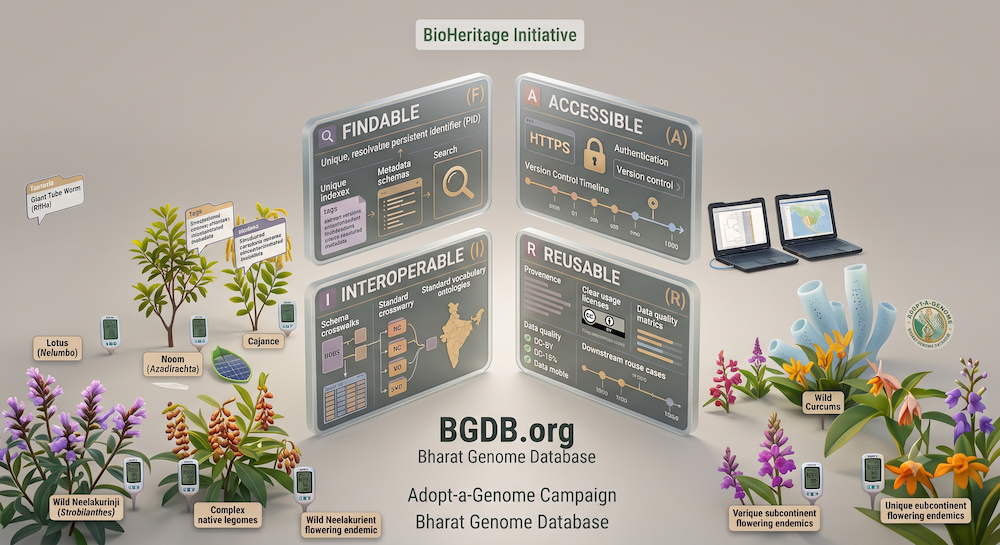
The Indian subcontinent represents an extraordinary evolutionary theater, harboring distinct ecological zones that range from the tropical evergreen forests of the Western Ghats to the high-altitude montane flora of the Himalayas. For millennia, these habitats have nurtured thousands of endemic plant species that possess vital agronomic traits, stress tolerance, and therapeutic secondary metabolites.
However, escalating habitat fragmentation and changing climatic regimes pose severe threats to this irreplaceable genetic heritage. At the Bharat Genome Database (BGDB.org), we are turning this challenge into a mandate for open science by building a centralized, open-access FAIR (Findable, Accessible, Interoperable, and Reusable) data infrastructure dedicated to conserving the living blueprints of native flora.
1. The Imperative for FAIR Genomic Data
High-throughput sequencing technologies generate vast amounts of genetic data, yet valuable information often ends up trapped in disconnected repositories or behind restrictive access barriers. The FAIR Data Principles establish the foundation for reproducible botanical and evolutionary research:
- Findable: Curated metadata, clean taxonomic cataloging, and persistent web identifiers make assemblies easy to discover for global and local research communities.
- Accessible: Direct, open-access availability without paywalls or restrictive data silos ensures public-good research remains universally available.
- Interoperable: Standardized genomic formats (GFF3, FASTA, BAM, VCF) enable cross-species comparative pipelines and multi-omics integration.
- Reusable: Permissive licensing models (CC-BY 4.0) encourage scientists, breeders, and conservation biologists to repurpose digital genomes for downstream discovery and crop improvement.
2. Integrated Genomic Tools and Analysis
BGDB.org provides a browser-native computing and visualization environment directly on top of curated plant assemblies:
- Interactive Visualization (JBrowse 2 & IGV): Inspect complex gene models, exon-intron boundaries, repeat landscapes, and structural variants without local installation bottlenecks.
- Targeted Sequence Alignment (BLAST): Query custom nucleotide and protein databases specifically benchmarked on subcontinent flora to identify homologous genes and syntenic regions.
- High-Throughput Annotation (VEDA): Automated eukaryotic structural and functional annotations are standardized using the VEDA (Versatile Engine for Data Annotation) framework, resolving complex repeat-rich genomes with high accuracy.
3. Preserving Living Heritage: The Adopt-a-Genome Campaign
Genomic preservation is an urgent priority for biodiversity protection. Under the BioHeritage Program powered by the Sivasakthi Science Foundation, BGDB actively drives the BioHeritage Program powered by the Sivasakthi Science Foundation, BGDB is driving the Adopt-a-Genome Campaign.
This crowdsourced and institutional initiative empowers researchers, academic institutions, conservationists, and citizen scientists to sponsor, sequence, annotate, and digitally safeguard the complete genetic blueprints of ecologically critical and endangered native plant species.
Explore and Collaborate
- Explore Assemblies: Browse curated plant genomes including Nelumbo nucifera (Lotus), Cocos nucifera (Coconut), Azadirachta indica (Neem), Santalum album (Sandalwood), and Cajanus cajan.
- Access Tools: Run sequence searches with BLAST or inspect assemblies via JBrowse 2.
- Join the Mission: Contact the team at research@bgdb.org to contribute dataset releases, collaborate on non-model genome projects, or adopt a native genome for sequencing!